

No-Till and Minimal Till
Sections in this Guide:
-
Brief History of No-Till Farming Adoption
-
Tillage Tools and Equipment
-
Important No-Till Management Considerations
-
Additional Resources on No-Till and Minimal Till
No-till farming is commonly defined as the process of planting directly into crop residues without disturbing or turning the soil. This farming strategy is known to protect soil structure, minimize soil erosion, build soil organic matter, and support soil biology.
While “no-till” sounds modern and is often associated with contemporary farming practices, the idea of disturbing the soil as little as possible is ancient. Indigenous farmers in North America planted a diverse range of crops together in living mulch, with groundcovers like squash covering the soil below upright growing crops like corn and beans to minimize the need for tillage to remove weeds. This intercropping practice is commonly referred to as the "three sisters" technique. Many African, Asian, and South American farmers used hand tools, surface mulches, and compost to grow crops without deep tillage as well. Their centuries of success feeding large civilizations with no-till and "conservation tillage" practices is historic evidence that fertile and productive soil can be managed effectively without the use of heavy plows and regular deep tillage.
In the late 1800s and early 1900s, steel plows and tractors made it easier to break millions of acres of prairie soil across the Great Plains of North America. But when drought hit the Great Plains in the 1930s, bare unprotected soils turned to dust. Massive wind erosion wiped out crops, drove families from their farms, and darkened skies hundreds of miles away. The U.S. government responded by creating the Soil Conservation Service (now NRCS) in 1935 to help farmers control erosion with practices like contour farming, grass strips, cover crops, no-till, and conservation tillage practices.
By the 1960s, specialized planters and drills were developed to place seed directly into heavy crop residue. Weed control technologies were also developed, with the introduction of the herbicide glyphosate in 1974 giving farmers an effective way to kill weeds without tilling. This was followed by the breeding of herbicide resistant ("RoundUp Ready") cash crops. These advances meant no-till could be scaled across large acreage. However, widespread use of glyphosate and other herbicides did introduce other challenges, including the emergence of herbicide resistant weeds and negative impacts of herbicides like glyphosate on soil health and nutrient availability.
By the 1980s, NRCS programs were promoting conservation tillage nationwide. Farmer innovators, university researchers, and equipment improvements helped facilitate no-till adoption, especially in corn, wheat, and soybean systems. In recent decades, the rise of cover crops and regenerative farming systems has reinforced the value of no-till. It serves as a foundational soil health tool for reducing soil disturbance, supporting soil health, and boosting farm profitability. Today, regenerative no-till farmers have developed management strategies that minimize or even eliminate the use of herbicides alongside no-till, instead relying on strategies like roller crimping cover crops to suppress weeds and protect soil.
Nearly 100 years since the Dust Bowl brought no-till farming into mainstream focus in the US, its adoption continues to grow. The figure below shows data from USDA surveys demonstrating the consistent growth of no-till and reduced tillage adoption by US farmers over recent decades. Today it is widely recognized that no-till and conservation tillage farming can significantly reduce soil erosion, boost soil health, conserve soil moisture, improve farm profitability, and build more resilient soils.
Brief History of No-Till Farming Adoption

Tillage Tools and Equipment
The table below summarizes the common tillage equipment and methods ranging from most intensive to least intensive. More intensive methods generally involve deeper tillage that inverts soil layers and therefore causes significantly more disturbance to beneficial soil microbes, hindering their populations over time and therefore negatively impacting soil health. Less intensive methods such as no-till, strip till, and vertical tillage involve shallower disturbance, less inversion, and therefore less disturbance and negative impacts to beneficial soil microbes and overall soil health. This table covers most common tillage equipment and management strategies, but the full scope of no-till and minimal equipment used by farmers far exceeds the scope of this guide.

Tillage practices vary heavily across different crops, with some row crops like corn and soybean produced with full no-till practices, while certain annual specialty crops like strawberries, lettuce, and tomato commonly involving several tillage passes throughout the course of a season. Different tillage practices are also commonly integrated and stacked to offer a combination of shallow disturbance (secondary till or vertical till) and deeper tillage practices. The infographic below provides a basic overview of the spectrum of tillage management ranging from conventional tillage, to reduced (minimal) tillage, to no-till. In these tillage management examples, soil disturbance and number of field passes with a tractor declines as you move to the right on the diagram. Reducing soil disturbance and field passes offer benefits both in terms of reduced negative impacts on beneficial soil biology from soil displacement and compaction, as well as lower fuel usage.
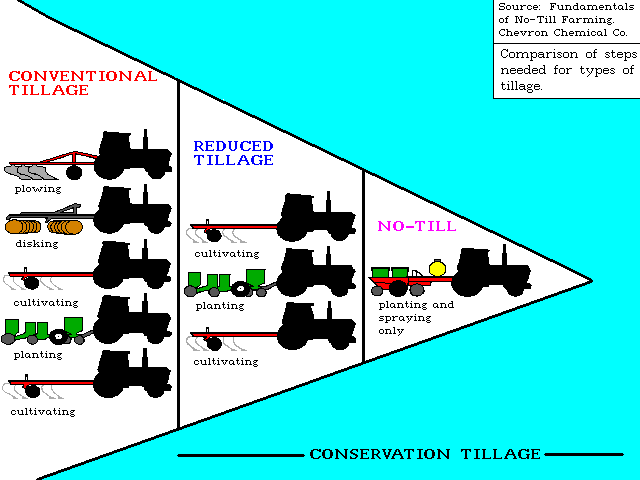
Specific tillage equipment and management varies depending on agronomic needs and crop turnover. In some cases, like soil prone to compaction, organic crop production, and high turnover specialty crops (e.g. lettuce and herbs) it is challenging to transition entirely to no-till. In these cases, minimal tillage practices like surface tillage, strip tillage, or vertical tillage can serve as solutions that disturb soil minimally while still offering the benefits of weed control and crop residue incorporation.
No-Till and Minimal Till Tools and Equipment
No-till and minimal tillage commonly rely on cultivator and planter equipment that enables farmers to plant into surface crop residue and still achieve effective seed placement and emergence. Below is a shortlist of common no-till and minimal tillage equipment. Please note that this is not a comprehensive list and specific equipment manufacturers may use different terminology for these tools.
No-Till Planters
No-till planters are designed to place seed directly into undisturbed soil covered with crop residue. They rely on heavy-duty frames, high down-pressure systems, and precise seed metering to achieve uniform depth and emergence in high crop residue conditions typical of no-till fields. Proper setup and adjustment are critical in no-till systems, where residue levels and soil moisture can vary widely. No-till planters are commonly used to plant cash crops in row crop production scenarios, such as corn, soybeans, and cotton.
Common attachments and components include:
-
Row cleaners: Move residue away from the seed row without disturbing soil, helping prevent hair-pinning and improving seed-to-soil contact.
-
Coulters or disc openers: Cut through residue and open a narrow seed trench.
-
Closing wheels: Firm soil around the seed to ensure good emergence, often adjustable for moisture conditions.
No-Till Drills
No-till drills function similarly to no-till planters but are designed for higher seed counts and narrower row spacing than no-till planters. They create narrow slits in the soil while maintaining surface crop residue, allowing crops to emerge effectively without prior tillage. Drills are often simpler than planters but still require sufficient weight and down-pressure to achieve consistent planting depth. No-till drills are commonly used for small grains, cover crops, and forage crops, which require higher density planting and narrower spacing than the cash crops like corn, soybean, and cotton that are typically planted with a no-till planter.
Roller Crimpers
Roller crimpers are heavy cylindrical rollers often designed with blunt blades running parallel along the cylinders. They are used to roll over cover crops which crimps the stems, stopping water nutrient flow and thus effectively terminating the cover crop without disturbing the soil. This lays down a thick layer of cover crop mulch which can be planted in using a no-till planter or drill. Timing of roller crimping is crucial, as cover crops must be at the proper growth stage during roller crimping to be fully terminated. If cover crops are terminated too early they can regrow and stand back up. Additionally, certain cover crops like ryegrass are challenging to roller crimp due to their lack of a rigid stem like cereal rye. Other cover crops like sorghum sudangrass are notoriously effective at regrowing after roller crimping and instead require other termination methods.
Strip Till Implements
Strip till tools are used to till only narrow rows of soil where the seed is typically planted, leaving the area between these rows undisturbed and covered with crop residue. Many strip-till units include coulters and fertilizer shanks or knives that apply fertilizer into the soil in a single strip till pass by injecting it a few inches deep into the soil. This allows nutrients, particularly nitrogen, to be placed just below the surface into the root zone where they are accessible to crops but not prone to volatilization or runoff risks like unincorporated surface applied fertilizer.
Vertical Tillage Implements
Vertical tillage tools include a range of implements that perform tillage at shallow depths (1-5 inches) while lightly cutting and incorporating crop residue, thus minimizing soil inversion and disturbance but still managing to support soil aeration and alleviate compaction. Unlike conventional tillage implements like discs, vertical tillage leaves at least 30-50% of the crop residue on the surface and prevents compaction layers or plow pans that can occur with heavy conventional tillage. Vertical tillage can be a very important tool in farming settings where heavy crop residue or soil compaction make full no-till adoption challenging. Like strip till implements, vertical till implements are sometimes outfitted with fertilizer injectors that apply nutrients into the root zone to ensure they are available to the crop but not as prone to loss as on the surface.
Important No-Till and Minimal Till Management Considerations
Soil Moisture and Temperature
-
No-till tends to increase soil moisture retention and delay drying and warming of the soil in the spring, so inform planting decisions by monitoring soil moisture closely and avoid planting into well saturated fields; planting in muddy conditions increases the risk of compaction and can hinder germination success by compacting furrow side walls.
-
If delayed soil drying and warming under no-till conditions is a major concern in cool regions with short growing windows, consider strip‑till, ridge‑till, or shallow vertical tillage to open and dry the seed zone while leaving residue.
-
In spring, delay planting until surface residue has dried from dew or light rain so it cuts cleanly instead of hair‑pinning into the seed slot.
-
For corn, prioritize soil temperature: plant when the seed zone is at least 50 °F and rising; avoid planting just ahead of a cold rain, which is harder on seeds in cool, moist no‑till soils.
-
For soybeans, no‑till often performs as well or better as planting moves later, because residue protects the soil surface and helps reduce late‑season moisture stress.
-
Use cover crops and biostimulants to boost soil microbial activity and increase water infiltration and aggregate stability, which improve both moisture management and the soil’s ability to warm up in the spring.
Compaction
-
If severe subsurface compaction is a known issue in a field transitioning to no-till; consider first correcting it with a deep tillage pass when soil is dry enough to fracture rather than smear.
-
Minimize compaction with controlled traffic, lower axle loads when possible, and staying off fields when they are wet.
-
Deep‑rooted cash crops or cover crops (e.g., radish, cereal rye, some brassicas) can help biologically loosen soil, relieve shallow plow-layer compaction, and improve soil structure in a process sometimes referred to as "bio-tillage".
-
Where subsurface compaction persists in strips or headlands, consider in‑row subsoiling or strip‑till with shanks ahead of the row while leaving inter‑rows undisturbed.
-
In no-till soils that gradually develop compaction issues, vertical tillage can serve as an effective tool to alleviate compaction while maintaining crop residue and minimizing major disturbance to beneficial soil biology.
Planter / Drill Setup and Residue
-
Set enough down‑pressure and use sharp openers to cut through residue, open a clean V‑slot, and maintain uniform depth across variable residue and soil conditions.
-
Use row cleaners to gently sweep residue off the row without digging and create a narrow clean strip for planting, with residue left between rows for protection.
-
Check and adjust seed depth regularly, especially with changing moisture or residue; uneven depth means different temperature and moisture at the seed and uneven emergence.
-
Adjust closing wheels (style, pressure, angle) until the seed is firmed and the slot sealed without sidewall compaction; check in the field with a hand trowel.
Fertility
-
Maintain proactive nitrogen management: consider starter N for corn in cool no‑till soils, split applications to match crop uptake, use Y-drop applications when possible, and adapt rates for residue levels and carbon-to-nitrogen ratio.
-
In long‑term no‑till, nutrients like P and K tend to stratify near the surface; take soil samples at multiple depths to diagnose nutrient stratification if it is a concern; use cover crops to facilitate nutrient movement via root channels and soil microbial nutrient cycling.
-
Favor banding or placing nutrients near the seed or future root zone rather than relying only on surface broadcast.
-
Consider converting some N input from inorganic to organic N fertilizers (fish hydrolysate, corn steep liquor, amino acids), especially on fields with high C:N ratio cover crop residue.
-
Use diverse rotations and cover crops to help cycle nutrients, add organic matter, and improve cation exchange capacity over time, which can stabilize fertility and enhance nutrient use efficiency.
-
Watch for micronutrient issues that can show up more clearly as soil biology and structure change; document deficiencies and address them with targeted applications rather than blanket treatments.
Rotation and Weeds
-
Use diverse cash crop rotations and cover crops to leverage allelopathic (weed suppressive) effects of crops like cereal rye and brassicas while maintaining weed suppressive surface crop residue; this underpins long‑term weed management success in no‑till and minimal till systems.
-
If post-emergent herbicides are used, consider tank mixing with fulvic acid which has been shown to increase herbicide efficacy and plant absorption by acting as a chelating agent while also providing a carbon source to soil microbes.
-
Terminate cover crops on time and with consistent, proven methods to keep them from seeding going into a cash crop rotation and reduce planting challenges.
Pests and Diseases
-
Crop rotation is your main disease management tool in no‑till; rotate away from host crops to reduce inoculum of residue‑borne diseases, and avoid planting the same crop or closely related crops back‑to‑back on the same field.
-
Scout diligently for residue‑associated pests (e.g., slugs, cutworms, seedcorn maggot).
-
Manage cover crops to avoid “bridging” pests between hosts: avoid letting grassy covers go to head, terminate on time, and prevent volunteer cereals that can harbor armyworms and other insects.
-
Choose hybrids and varieties with strong disease resistance packages or early vigor if seedling diseases are a concern.
-
Use residue distribution to your advantage: spread combine residue evenly and avoid thick mats that hold moisture and create localized zones of higher disease and slug pressure.
-
For soil‑borne and seedling diseases favored by cool, wet conditions, pair no‑till with biofungicide seed treatments, proper planting depth, and wait for fit soil temperatures to reduce damping‑off and early root rots.
Additional Resources on No-Till and Minimal Till
