

Soil Biology 101
Sections in this Guide:
-
Intro to Soil Biology and the Relationships between Plants and Soil Microbes
-
List of Beneficial Roles and Functions that Soil Biology Offers to Crops
-
Moving From Degenerative to Regenerative Relationships between Plants and Soil Biology
Until the development of modern technology like microscopes and DNA testing, humanity knew very little about the microbiomes that exist around and inside of us. But today it is well known that our homes, water, hands, and even our stomachs and other organs are (naturally) covered with populations of tiny microorganisms or "microbes", including bacteria, fungi, and many other microscopic creatures that make up populations collectively known as microbiomes. Our soil is no different. Vast populations of living microorganisms inhabit farmland soil and play very similar roles supporting plants that they play supporting us by working as probiotics in our digestive systems to break down our food into absorbable nutrients. Plants and microbes have complex natural relationships that can be leveraged with regenerative agriculture management to increase crop productivity and reduce reliance on external inputs.
"Far more microorganisms out there in the soil are beneficial to plant growth than are pathogens"
For much of modern human history, conventional agriculture has generally disregarded the management of soil biology and instead focused primarily on managing soil chemical properties (nutrients, pH) and physical properties (texture, tillage). Conventional management of soil biology is typically focused only on managing soilborne diseases. However, modern research and innovative regenerative farmers continue to demonstrate that the importance of managing soil biology extends very far beyond simply biological disease management. In fact, it is now widely understood that far more microorganisms out there in the soil are beneficial to plant growth than are disease causing pathogens. It has even been proven that in healthy soils certain strains of common pathogens like Fusarium can live inside a plant and perform beneficial roles like nutrient cycling or pest defense, without posing a threat as a disease. However, when soil microbiomes are stressed and disturbed by intensive agricultural management or harsh environmental conditions, pathogens can become increasingly problematic to crops as they resort to infecting plant tissue to obtain their food while stressed out by disturbance.
One groundbreaking demonstration of the importance of soil biology emerged from a series of studies at the University of Illinois. These studies evaluated the sources of nitrogen absorbed by corn plants by chemically labeling the nitrogen fertilizer applied to the fields to distinguish nitrogen taken up by the crop from fertilizer and compare these values to levels of nitrogen provided by the surrounding environment. The results showed that on average only about 33% of nitrogen content in a corn plant comes from nitrogen fertilizer, while the remaining 67% of nitrogen in the corn plant is derived from non-fertilizer sources in the soil environment. Soil biology is largely responsible for influencing these non-fertilizer nitrogen sources in the soil environment that we now know can account for a majority of a corn plant's nitrogen content.
Intro to Soil Biology and the Relationships Between Plants and Soil Microbes
Soil microbes form complex relationships with crops, trading resources and services to support each other. As crops perform photosynthesis, they produce sugars. A portion of these sugars are transported by the crop down through its roots and released into the soil to provide food for microbes referred to as root exudates. In a healthy agricultural soil, beneficial soil microbes gather around crop roots to receive and feed on these root exudate sugars to supply themselves with carbon, an essential element for all life. In exchange, soil microbes provide the crop with nitrogen and other nutrients by converting them from forms otherwise unavailable to the crop, such as nitrogen gas or phosphorus that is locked up and bound as a mineral in the soil to other compounds like calcium. Soil microbes also reward crops for the sugars they receive as root exudates by protecting the plants from pathogens, and can even help crops tolerate environmental stressors like drought, heat, and wind by supplying the crop with plant growth regulators (PGRs) like the plant hormones auxin and cytokinin, as well as other signaling molecules that prime the plant's resilience to stress or pathogen invasion.
The relationship or "resource network" shared between soil biology and crops is similar in theory to a supply chain network, as outlined by the diagrams below. Both involve the exchange of goods and resources in mutually beneficial transactions. In a basic supply chain, raw goods are produced or sourced and then typically undergo a manufacturing and distribution process before being sold to the end user in exchange for money for the costs of the manufacturing and supplying the product.
.png)
Microbes act as a manufacturing and supply team for the plant by converting "raw" nutrients in the soil environment from plant unavailable forms bound to organic matter, stuck in gaseous forms, or locked mineral compounds (like calcium or aluminum), into plant available forms. Some microbes, like mycorrhizal fungi, are also known to transport nutrients and water to the plant root like distribution networks in a supply chain. As microbes "manufacture" and "transport" nutrients and other beneficial resources to the crop, the crop "pays" the microbes by releasing some of its sugars produced through photosynthesis into the soil profile as root exudates. Microbes feed on these root exudates and also consume crop residues through the process of decomposition. Additionally, beneficial microbes rely on the crop's root system for habitat while they provide another service to crops by defending it from pathogens and soilborne pests.
Fascinatingly, plants can even alter the contents of their sugar-rich root exudates to signal which resources they need from the soil microbes consuming those root exudates. If a crop needs nitrogen it may send out signals to stimulate nitrogen fixing microbes. Or if the crop is under a lot of stress it may release signals that select for soil microbes that can help prime its ability to tolerate that stress.
In summary, the practical importance of plant-microbe relationships in regenerative agricultural management is evident based on the the roles that soil biology plays, including supplying a major portion of an average crop's nutrients and offering defense against pathogens and stress. Aside from these direct roles, soil biology also builds organic matter, which improves the texture, water holding capacity, and nutrient holding capacity of soil. Soil microbes are a major reason why some rich fertile river bottom and muck agricultural soils require little to no applied fertilizer. If you have ever heard the term "disease suppressive soil" in reference to soil that shows a year-after-year absence of plant disease impacts compared to surrounding fields, then beneficial disease suppressive soil biology may very likely is a major contributor to the soil's lack of disease impacts. Likewise, if you have ever experienced or seen a field that showed far less negative impacts of drought, extreme heat, or even wind or hail than nearby fields, beneficial soil microbes commonly play a role in crop resilience to these environmental stressors and may explain how those differences occurred.
List of Beneficial Roles and Functions that Soil Biology Offers to Crops
As discussed in the previous section, soil microbes can offer a wide range of biological benefits to crops. The diagram below lists important biological functions that microbes perform in order to sustain crop growth and productivity. These are ultimately drivers of yield and a major reason why highly biologically active soils that are high in organic matter tend to achieve higher yields with less need for inputs than poorer soils. For simplicity, soil microbe functions are divided here into three main categories, nutrient cycling, plant stress tolerance, and plant disease protection. Please note that this list is not intended to be comprehensive of all beneficial soil microbial functions, just the most well established, understood, and agronomically relevant soil biology functions.
.png)
Moving from Degenerative to Regenerative Relationships between Plants and Soil Biology
As modern conventional agronomic science was developed during the Green Revolution of the 1900s, the invention of synthetic fertilizers led to major crop yield increases year after year. The ability to apply immediately plant available nitrogen, phosphorus, and potassium was a game changer for yields because previously crops were limited to only being able to uptake these macronutrients from slower release organic forms, such as compost, manure, raw minerals, or crop residues. Soluble synthetic fertilizers overcame this limitation to yield, and therefore became a standard chemical soil management tool, alongside chemical crop protection products to control diseases, weeds, and insects.
However, after decades of using these modern fertilizer and crop protection technologies as prescribed by modern agronomic science, yield increases have slowed across many farming regions and other limitations to yield have emerged. Declines in organic matter, soil texture, soil biology, and crop resilience have been attributed to intensive use of these modern chemical technologies. Heavy use of high salt index fertilizers and antimicrobial crop protection products like fungicides have shown adverse impacts on soil health. Crop pathogens, pests, and weeds continue to develop resistance to modern crop protection products. These long term symptoms are what can be referred to as "degenerative" agriculture, which is when agricultural management practices reduce the long-term efficiency and productivity of a farm system, rendering it increasingly dependent on external inputs and thus raising costs in order to maintain yield. After decades of using soluble chemical fertilizers, they are no longer the main bottleneck to yield across many acres.
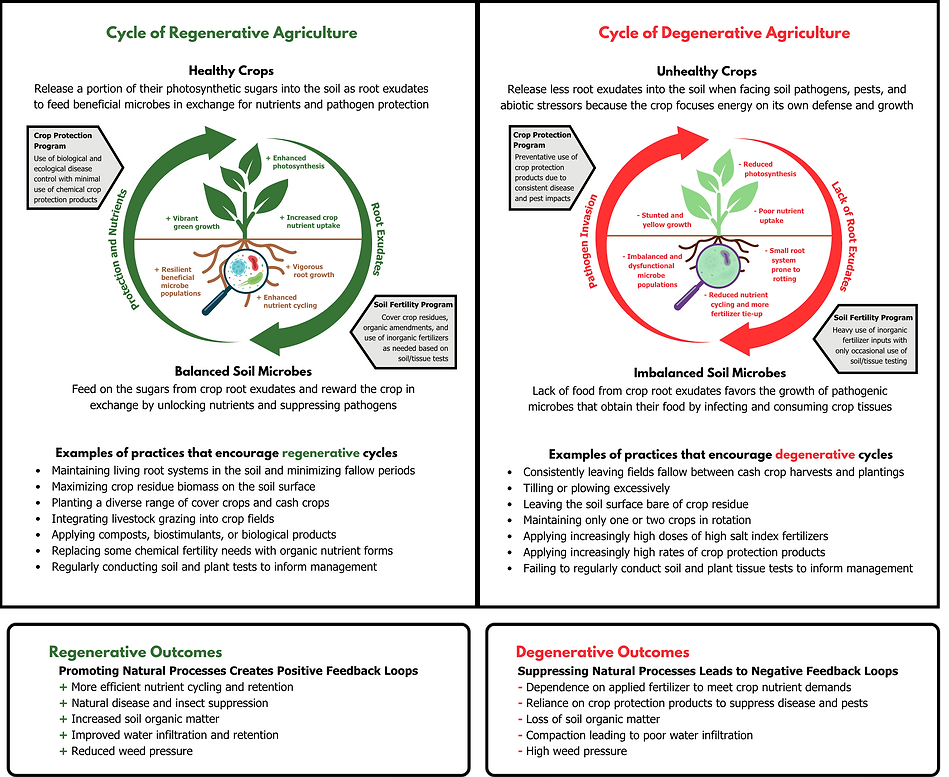
In many ways degenerative agriculture is a process of negative feedback cycles. For example, heavy use of fertilizer and crop protection products can cause an imbalance in soil microbe populations, leading to reduced nutrient cycling and rises in crop disease outbreaks, which further increases the need to apply fertilizer and crop protection products to maintain yields, and this can also further hurt soil microbes.
Regenerative agriculture management aims to reverse this vicious cycle and instead establish positive feedback cycles, in which healthy crops maintain mutually beneficial relationships with soil microbes that enhance the efficiency and productivity of the crops. The diagram below provides a basic example of a positive "regenerative" feedback cycle and a negative "degenerative" feedback cycle.
.png)
Regenerative ag is considered to be a toolkit and philosophy, not a strict rulebook (like organic ag)
Adoption of regenerative agricultural management involves reducing use of synthetic crop protection products and chemical-based fertilizers in the process of promoting soil biological processes that serve in their place. However, use of agrochemical products during a transition period to regenerative farming is commonplace. Depending on context, some farms are able to fully transition to regenerative management with zero synthetic agrochemical input use, while others may require a gradual transition away from these inputs and occasional long term use of synthetic agrochemicals in a prudent and proactive manner that minimizes any negative impacts on soil biology.
The timeline, inputs, and management practice changes involved in regenerative management adoption vary widely across farm contexts, but the philosophy of promoting regenerative biological cycles while minimizing degenerative cycles remains consistent in any successful regenerative farm operation regardless of the different practices used to achieve this.
Additional Resources on Soil Biology
